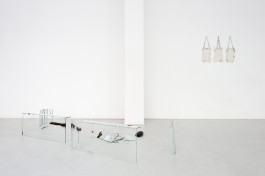
I read that pigeons are known for being notoriously bad at building nests. Funny that we find this so funny.
2026
Hand-cut glass, silicone, cable ties, car rear lights hearts, wheel cover tears, wing mirror housing, brass tears, branches, analog photographs on fujifilm and fine art paper.
Variable dimensions
Installation at Neun Kelche e.V, Berlin, Germany
Photographs : Dorothea Dittrich
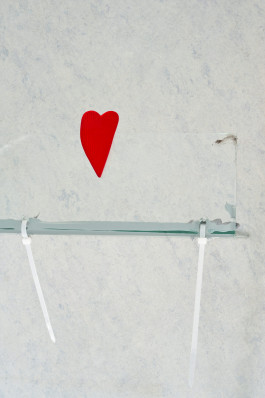
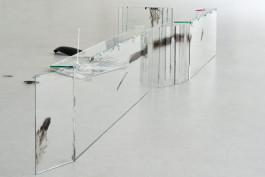
“I read that pigeons are known for being notoriously bad at building nests. Funny that we find this so funny” brings together hand-cut glass, bathroom silicone, cable ties, branches, found automotive parts, cast brass tears, and hearts and tears cut from car rear lights, with analogue photographs taken in and around domestic and construction sites. The glass was cut by hand from one-metre-by-one-metre found glass sheets.
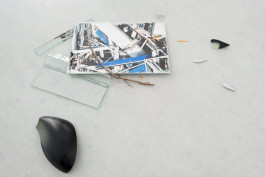
One photograph shows a pile of plastic window frames accumulated at a recycling site during the dismantling of a building. The photograph is itself roughly framed between two pieces of glass, held together with silicone rubber, echoing the improvised construction of the sculpture. Others show my father’s home in Bosnia and Herzegovina, including his redecorated living room and an improvised renovation of his balcony.
The work takes the pigeon’s famously poor nest-building as a point of departure, turning the joke back towards our own ways of building. A nest, a home, a room, a building, a life, a society: I think of these as things we construct over time, from whatever is available to us. We build, repair, decorate, adapt, dismantle and rebuild. The work asks what we might find in these structures when we look at where they come from, what they carry, and what we continue to build from them. What we inherit can be both foundation and ruin: the material from which we build, and the structures, patterns and dysfunctions we keep rebuilding.
The labour of making the sculpture is part of this logic. Cutting by hand the glass from two one-metre-by-one-metre sheets was a laborious process, and the pieces were assembled roughly with bathroom silicone and cable ties. Its awkward construction remains visible, echoing the improvised ways in which we make things hold together. The hearts and tears introduce the body into this architecture: the body as another kind of home, and the heart as a small gesture of self-love within an otherwise precarious construction.
Moving between nest, shelter, domestic interior, construction site, body and ruin, the work reflects on our impulse to keep building; even when the structures we create, individually and collectively, have become increasingly dysfunctional.
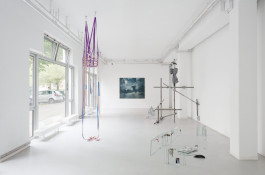
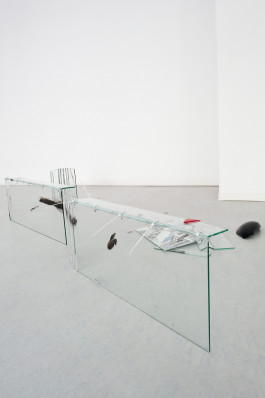
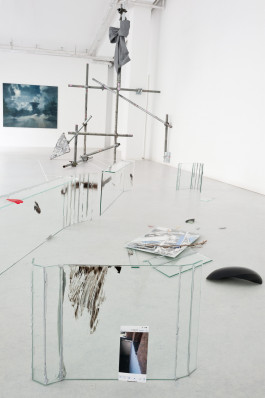
I read that pigeons are known for being notoriously bad at building nests. Funny that we find this so funny.
2026
Hand-cut glass, silicone, cable ties, car rear lights hearts, wheel cover tears, wing mirror housing, brass tears, branches, analog photographs on fujifilm and fine art paper.
Variable dimensions
Installation at Neun Kelche e.V, Berlin, Germany
Photographs : Dorothea Dittrich
“I read that pigeons are known for being notoriously bad at building nests. Funny that we find this so funny” brings together hand-cut glass, bathroom silicone, cable ties, branches, found automotive parts, cast brass tears, and hearts and tears cut from car rear lights, with analogue photographs taken in and around domestic and construction sites. The glass was cut by hand from one-metre-by-one-metre found glass sheets.
One photograph shows a pile of plastic window frames accumulated at a recycling site during the dismantling of a building. The photograph is itself roughly framed between two pieces of glass, held together with silicone rubber, echoing the improvised construction of the sculpture. Others show my father’s home in Bosnia and Herzegovina, including his redecorated living room and an improvised renovation of his balcony.
The work takes the pigeon’s famously poor nest-building as a point of departure, turning the joke back towards our own ways of building. A nest, a home, a room, a building, a life, a society: I think of these as things we construct over time, from whatever is available to us. We build, repair, decorate, adapt, dismantle and rebuild. The work asks what we might find in these structures when we look at where they come from, what they carry, and what we continue to build from them. What we inherit can be both foundation and ruin: the material from which we build, and the structures, patterns and dysfunctions we keep rebuilding.
The labour of making the sculpture is part of this logic. Cutting by hand the glass from two one-metre-by-one-metre sheets was a laborious process, and the pieces were assembled roughly with bathroom silicone and cable ties. Its awkward construction remains visible, echoing the improvised ways in which we make things hold together. The hearts and tears introduce the body into this architecture: the body as another kind of home, and the heart as a small gesture of self-love within an otherwise precarious construction.
Moving between nest, shelter, domestic interior, construction site, body and ruin, the work reflects on our impulse to keep building; even when the structures we create, individually and collectively, have become increasingly dysfunctional.